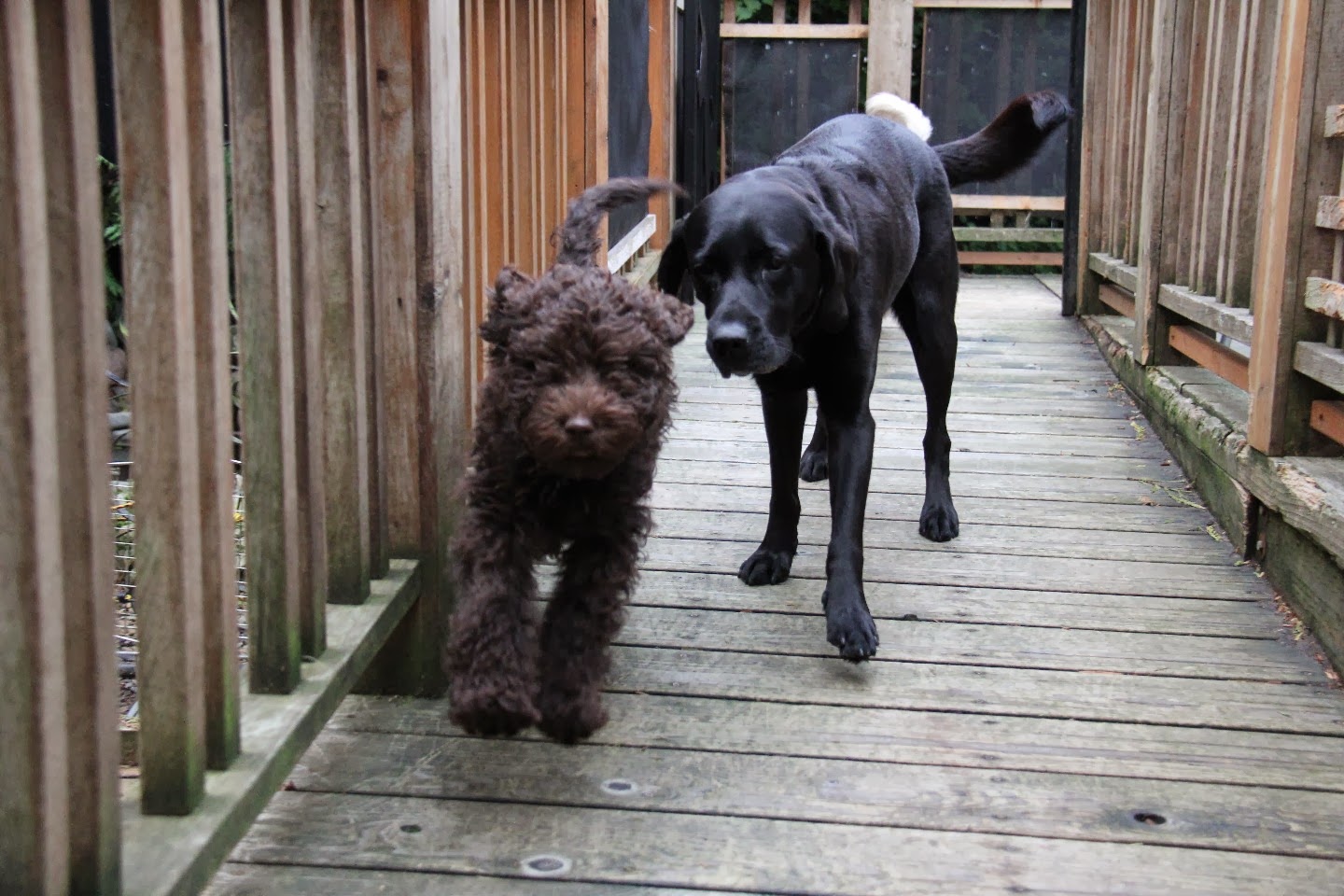
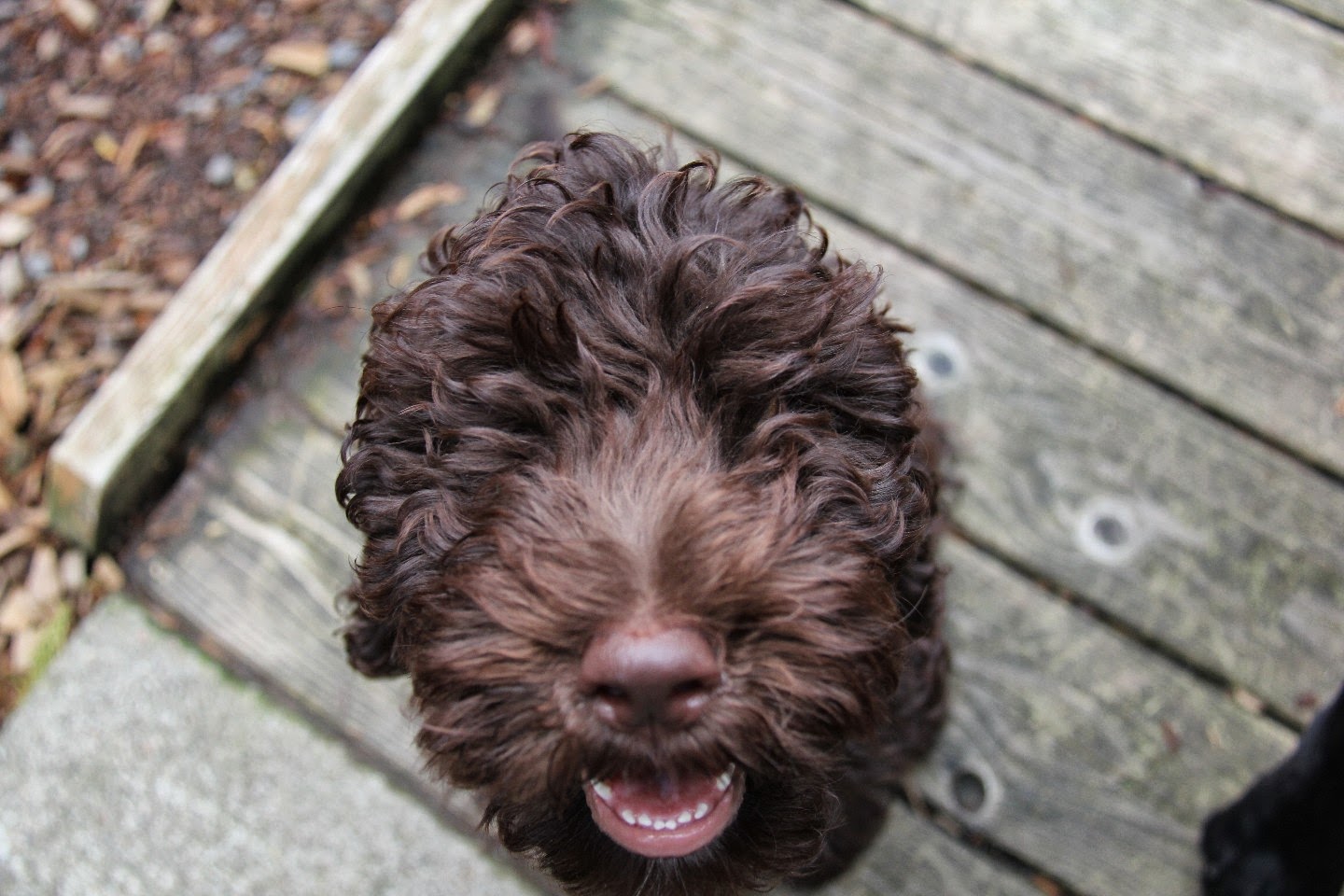
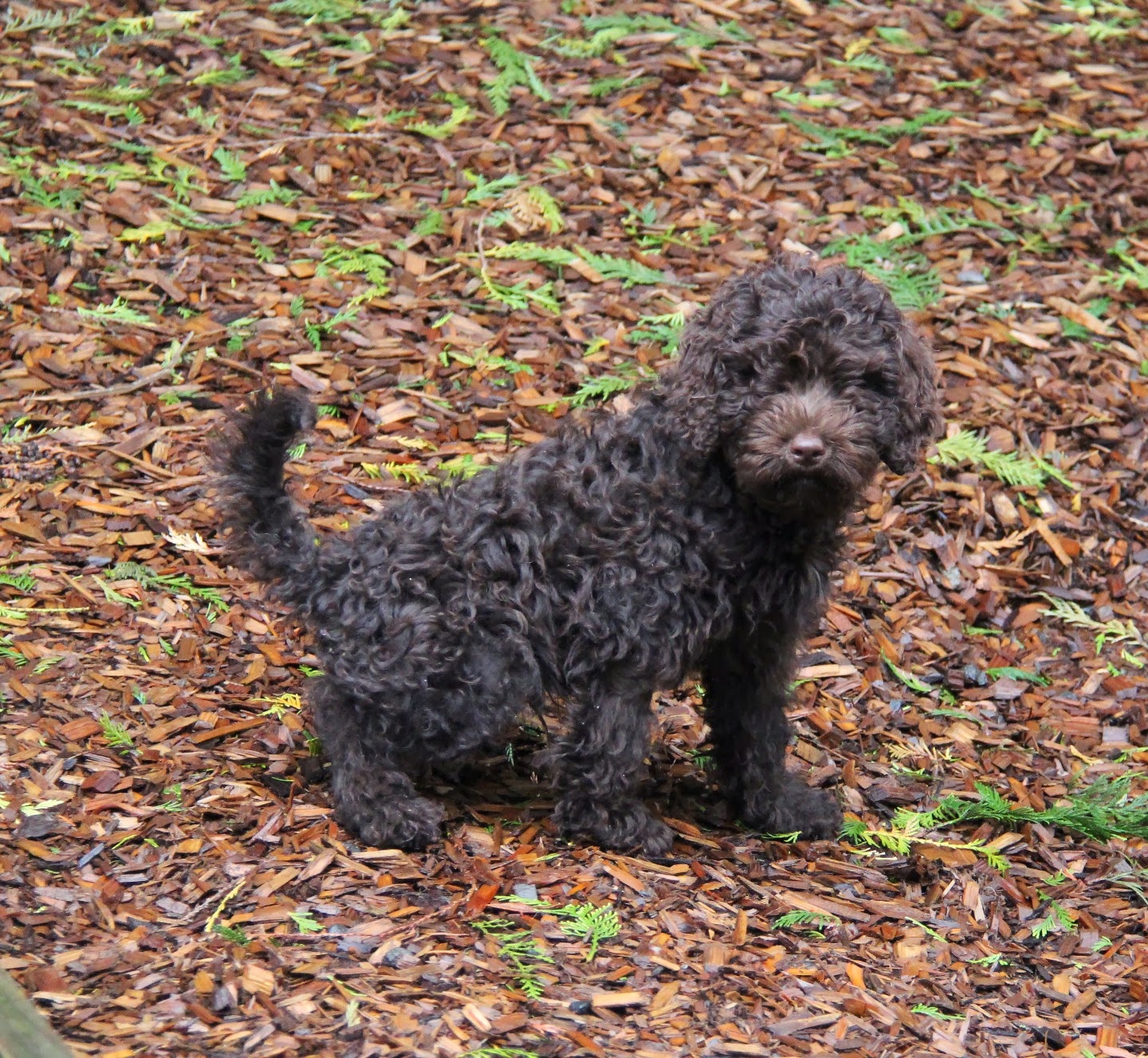
Ubu has a lot of work ahead of him. Service work can be very challenging for a dog. They need to learn to inhibit very normal dog behaviors (sniffing, scratching, barking, etc.) while they are in public places. This can be pretty demanding on a dog. Not to mention all of the things that they need to take with a grain of salt when they are out in public. Dogs are not usually naturally comfortable in all environments which is why we spend so much time socializing puppies. But all of this can be a bit stressful for a dog so it's really important to find balance in his life.
Balance means time to just be a dog.
Balance means play...with dogs too but most with people.
It's about making training fun, smiling at your dog, and giving him a lot of positive feedback.
A huge part of the training is teaching a dog to love their work. You still need to be firm and set boundaries with a dog, but fostering a relationship built on cooperation rather than force is going to take you much further.
So he needs to study hard. Our first set of goals has to do with the Canine Good Citizen test (http://www.akc.org/events/cgc/training_testing.cfm). These are very basic skills which will be a foundation for a lot of his other skills he will learn later on. Eventually he will need to pass the Public Access Test (http://www.assistancedogsinternational.org/standards/public-access-test/) and then, of course, any additonal skills he may need to learn to do his job. Hard work!
So make sure he has opportunities to work hard and play hard.
You'll find that a happy dog who loves his work will work so much better than a dog who is doing it simply because that was what he was taught and told to do.
Not to mention that it's a lot more fun for everyone involved.
Saturday, October 5, 2013
Day Ten -- Distractions
It would be so grand if dogs were as attentive out in the real world as they are at home with few distractions. But, out in the real world, leaves blow in the wind, dogs pass us on the sidewalk, kids squeal, and the smell of food tempts most dogs.
We want him to be able to walk past the distraction without lunging or pulling on the leash.
Ideally he is checking in with us periodically and looking to us for direction.
It's ok for Ubu to look at the distraction. Dogs need to be able to see what is going on around them in their environment.
But he does need to respond if you say his name or give him a command.
Because he's a baby and still just learning, you may have to get farther away from the distraction in order to get his attention. Distance is your friend when it comes to distractions.
When there are distractions present, I'm going to reward more frequently for eye contact and talk to him more to help keep him engaged with me.
It really helps that he is already so keyed into people but distractions are still something we want to work on now so he doesn't get in the habit of sloppy leash skills and inappropriate behavior in public.
It's a good thing we have a lot of dogs to practice our distractions with.
Working on this a little bit throughout the day and wherever you go with him will go a long ways towards having a really responsive adult dog.
We want him to be able to walk past the distraction without lunging or pulling on the leash.
Ideally he is checking in with us periodically and looking to us for direction.
It's ok for Ubu to look at the distraction. Dogs need to be able to see what is going on around them in their environment.
But he does need to respond if you say his name or give him a command.
Because he's a baby and still just learning, you may have to get farther away from the distraction in order to get his attention. Distance is your friend when it comes to distractions.
It really helps that he is already so keyed into people but distractions are still something we want to work on now so he doesn't get in the habit of sloppy leash skills and inappropriate behavior in public.
It's a good thing we have a lot of dogs to practice our distractions with.
Working on this a little bit throughout the day and wherever you go with him will go a long ways towards having a really responsive adult dog.
Friday, October 4, 2013
Day Nine -- Stay
Stay means to not move from a position like sit or down. Ubu is a bit young to have a nice solid stay but we can certainly get him started on it. Stays are broken down into three components when teaching it; duration, distance, and distraction. Working on each component separately in the beginning will given us a much greater chance of success. He's still a baby so, if we were to work on more than one component at a time, we would likely both end up frustrated and he will have learned only to break his stay.
I like to start with duration, which simply means how long he can stay in a position. I find this helps him understand what I'm asking of him.
I start out with a handful of tiny treats. I ask him to sit and say "stay." I then feed him one treat after the other while he is still in his sit. The short intervals between rewards will help him figure out that it pays off to stay in that position.
As he improves, I can decrease the intervals between rewards. Notice, too, that I am delivering the treats to him low and at his level. If I held the treats high, he is likely to break his stay and leap up to try to get the treats. In the beginning, I'm going to get the sessions very short. As he improves, I can make the sessions a little longer.
If he starts to break, just a simple, "No, stay" in a calm voice followed up with a hand signal and praise when he complies. That lets me know that I either wasn't rewarding as often as I needed to, my session was too long, or there is some distraction in the area that we need to eliminate.
We'll start working on distractions and distance a bit later. He's not quite ready for that yet.
But he'll get there!
I like to start with duration, which simply means how long he can stay in a position. I find this helps him understand what I'm asking of him.
I start out with a handful of tiny treats. I ask him to sit and say "stay." I then feed him one treat after the other while he is still in his sit. The short intervals between rewards will help him figure out that it pays off to stay in that position.
As he improves, I can decrease the intervals between rewards. Notice, too, that I am delivering the treats to him low and at his level. If I held the treats high, he is likely to break his stay and leap up to try to get the treats. In the beginning, I'm going to get the sessions very short. As he improves, I can make the sessions a little longer.
If he starts to break, just a simple, "No, stay" in a calm voice followed up with a hand signal and praise when he complies. That lets me know that I either wasn't rewarding as often as I needed to, my session was too long, or there is some distraction in the area that we need to eliminate.
We'll start working on distractions and distance a bit later. He's not quite ready for that yet.
But he'll get there!
Thursday, October 3, 2013
Day Eight -- Visit with Family
We had a nice visit with family! Ubu is such a social guy, he gets really excited when he sees people. Keeping everyone on the same page about how to handle his greetings will be very important.
So, to recap some of the things we talked about, look for signs that he needs to go outside to the bathroom. He usually heads to the door and hovers around the door when he needs to go out. Sometimes he will vocalize a little (whine). This is great! He is showing that he understands what he needs to do. Now, his body just needs to catch up a little bit. These are great signs but, if you miss them, he will go find a spot in the house to go to the bathroom because he doesn't have the control yet. Feeding scheduled feedings help predict when he will need to go to the bathroom.
I'm still going outside with him so I can cue him to go to the bathroom ("hurry, hurry"). Then I can quietly praise him when he goes to the bathroom (if my praise is too enthusiastic I might interrupt him and end up with a half full bladder). It's also important that I am out there with him so I make sure he does his business and he's not just playing around. If he does have an accident in the house and I catch him in the act, I can interrupt him and quickly usher him outside. If I don't catch him in the act, the only thing I can do is clean it up and use and enzymatic cleaner to eliminate the smell.
If I take him out and he doesn't go to the bathroom when I expect him to, I can put him in his crate for 15 - 20 minutes and try again. This is not punishment! This is simply to confine him so he doesn't have an accident. And speaking of crates, Ubu loves his crate. He will readily go in when I say "kennel." I toss a treat in after him to reinforce this behavior (note: I do not get a treat out to bribe him to get in, I toss it in AFTER he has gone in). Sometimes he will vocalize a little bit in the crate (especially in a new environment). Just ignore this and it will die down. The crate is a great place to confine him when you can't keep an eye on him or you are leaving the house. He also sleeps in his crate at night.
I started to feed him three times a day to see if we could get him to eat more. If that doesn't work, we might want to try adding something to his food to bulk up the calories a bit. Notice that he is sitting nicely for his meal. He should remain sitting until I put the food bowl down and say "Ok." Having dogs sit for things they want (food, attention, going outside, putting his leash on, etc.) is a nice way of having them "say please" for what they want.
You can also take part of his meals on the go with you so you can reward him for behavior you like throughout the day. Polite greetings (sitting for greetings), lying down next to you on the floor next to the couch, chewing on chew toys, etc. can all be rewarded throughout the day as you catch him doing behavior you like. He also needs to be supervised at all times so you can interrupt behavior you don't like (i.e. putting his feet on the couch). Any time you interrupt behavior you don't like, redirect to a better activity and praise him when he is doing a more appropriate behavior.
Keep plenty of toys around to keep him entertained and chewing on appropriate things.
His chewing will increase as his deciduous teeth start to fall out and his adult teeth start to come in. If he has been reinforced for chewing on appropriate things it will save the legs of your furniture. He's a pretty good boy so I don't think you will have problems with his chewing.
So, to recap some of the things we talked about, look for signs that he needs to go outside to the bathroom. He usually heads to the door and hovers around the door when he needs to go out. Sometimes he will vocalize a little (whine). This is great! He is showing that he understands what he needs to do. Now, his body just needs to catch up a little bit. These are great signs but, if you miss them, he will go find a spot in the house to go to the bathroom because he doesn't have the control yet. Feeding scheduled feedings help predict when he will need to go to the bathroom.
I'm still going outside with him so I can cue him to go to the bathroom ("hurry, hurry"). Then I can quietly praise him when he goes to the bathroom (if my praise is too enthusiastic I might interrupt him and end up with a half full bladder). It's also important that I am out there with him so I make sure he does his business and he's not just playing around. If he does have an accident in the house and I catch him in the act, I can interrupt him and quickly usher him outside. If I don't catch him in the act, the only thing I can do is clean it up and use and enzymatic cleaner to eliminate the smell.
If I take him out and he doesn't go to the bathroom when I expect him to, I can put him in his crate for 15 - 20 minutes and try again. This is not punishment! This is simply to confine him so he doesn't have an accident. And speaking of crates, Ubu loves his crate. He will readily go in when I say "kennel." I toss a treat in after him to reinforce this behavior (note: I do not get a treat out to bribe him to get in, I toss it in AFTER he has gone in). Sometimes he will vocalize a little bit in the crate (especially in a new environment). Just ignore this and it will die down. The crate is a great place to confine him when you can't keep an eye on him or you are leaving the house. He also sleeps in his crate at night.
I started to feed him three times a day to see if we could get him to eat more. If that doesn't work, we might want to try adding something to his food to bulk up the calories a bit. Notice that he is sitting nicely for his meal. He should remain sitting until I put the food bowl down and say "Ok." Having dogs sit for things they want (food, attention, going outside, putting his leash on, etc.) is a nice way of having them "say please" for what they want.
You can also take part of his meals on the go with you so you can reward him for behavior you like throughout the day. Polite greetings (sitting for greetings), lying down next to you on the floor next to the couch, chewing on chew toys, etc. can all be rewarded throughout the day as you catch him doing behavior you like. He also needs to be supervised at all times so you can interrupt behavior you don't like (i.e. putting his feet on the couch). Any time you interrupt behavior you don't like, redirect to a better activity and praise him when he is doing a more appropriate behavior.
Keep plenty of toys around to keep him entertained and chewing on appropriate things.
His chewing will increase as his deciduous teeth start to fall out and his adult teeth start to come in. If he has been reinforced for chewing on appropriate things it will save the legs of your furniture. He's a pretty good boy so I don't think you will have problems with his chewing.
Wednesday, October 2, 2013
Day Six -- Leave It
There are times when we don't want our dog to sniff, lick, chase, or otherwise bother things in the environment. It might be food on the floor, a cat running across the street, another dog you are passing on the sidewalk, or the person who just entered the room who is a little nervous around dogs. There are also times when a dog has something in their mouth and you need them to readily drop the item. There are two separate commands for those two skills.
To teach "leave it," I started out with low value treats in one hand and higher value treats in my other hand (hidden from Ubu). In an upbeat voice, I said "Ubu, leave it." Then I waited. I waited for Ubu to try different things to get the treat (note: I started out with a closed hand. In this picture we had graduated to an open hand). I wanted him to realized pawing at it and nudging my hand would not work.
The second he backed off or looked away, I marked it with "Yes!" and gave him a high value treat from the other hand. Now he's starting to figure out that, if he leaves that pile of treats, he'll get an even better treat. As he improves, I can start to move my hand closer to the floor until I'm actually putting the "leave it" pile of treats on the floor. I can quickly cover it with my hand or foot if he dives for it (or close my hand if the treats are in my hand).
Once we've transitioned to our "leave it" pile on the floor, we're starting to teach him not to eat off the floor. This is an important skill for a Service Dog. It's not appropriate for a Service Dog to eat anything off the floor (imagine going to a restaurant and the dog is eating scraps off the floor...not a polite behavior when out in public and it could be dangerous for him if he ate the wrong thing). We can move beyond the pile of treats to every day objects and even things like cats and squirrels. When done in a happy tone with praise and rewards, you end up with a dog who is really happy to leave things when you ask him to.
It's no easy task when that darn cat starts to go after the "leave it" pile.
For those times when he has something in his mouth that we want him to spit out, we use the word "drop." We start out teaching this with toys. While he's playing with a toy, I can say "Ubu, drop" in an upbeat tone. Then I put a smelly treat under his nose until he drops the toy.
As soon as he does, I say "Yes," give him the treat, and put the toy behind my back. To make it an even more powerful reward, I give him the toy back. So he's starting to learn that dropping things really pays off well for him. He gets praise, a treat, and he gets the toy back. That's a pretty good deal.
So the reason we use an upbeat tone when we're asking him to drop is to foster a relationship built on cooperation rather than conflict. Using a harsh tone and demanding he complies could cause him to be more defensive ("Great, here she comes again and she's going to take all my good stuff"). We also don't want to chase after him when he has something we want him to drop. As soon as you chase, he will likely run in the opposite direction and he may think you have engaged him in a fun game of keep-away. Better to call him to you and ask him to drop. You are likely to get a much better response.
Treats make it worth his while to cooperate with you. Then he's happy to do things for you, which makes you happy, and improves your relationship overall. It's much nicer than the battle of the wills, which you are likely to win because you are bigger than him, but it doesn't leave anyone feeling all that great about the relationship.
Tuesday, October 1, 2013
Day Seven -- Let's Go
Some dogs hate to go out in the rain, even to go to the bathroom. It can be quite a challenge when you live in Oregon. Ubu, however, is not one of those dogs. It makes life so much easier when he will readily go out in the rain.
It means we can still get all our training done even when the weather is bad. Maybe our pictures aren't the best but we do what we can. When we're working on "Let's Go," which is the command to have him walk nicely beside you, we always want to make sure we have a nice, loose leash. If it's a tight leash, he won't learn how to walk properly on the leash. Besides, we want to put the responsibility of walking nicely beside you on him. If we have a tight leash, all that responsibility is on us.
Before we start out and whenever we stop, I want him to come to a sit beside me. This keeps him in a controlled position and it let's him know he's still on task. Leash work should be practiced on both sides so you can easily transition him to walking on either side of you.
While he's walking, I'm going to talk to him, pat my leg, and reward him periodically to keep him in position. If I see a distraction ahead, I will reward more frequently to keep his attention on me. If he gets ahead of me, I will either stop moving forward or I will turn the opposite direction. Continuing to move forward when a dog is pulling on leash is a sure fire way to teach a dog to pull on leash.
It's great if your dog checks in with you while you are walking. You want him to look to you for direction. He still needs to be able to scan his environment and see what's going on around him but you do want him to stay connected to you too. So paying attention to him, smiling and praising him when he checks in with you is really important. And, of course, in the beginning, short training sessions are important. Too long of sessions will likely result in a puppy with poor leash skills. Their poor little brains can handle too much learning all at once and it's a lot of work to learn how to walk nicely on leash. It's a lot of work but all the hard work you put in now will pay off big in the long run!
It means we can still get all our training done even when the weather is bad. Maybe our pictures aren't the best but we do what we can. When we're working on "Let's Go," which is the command to have him walk nicely beside you, we always want to make sure we have a nice, loose leash. If it's a tight leash, he won't learn how to walk properly on the leash. Besides, we want to put the responsibility of walking nicely beside you on him. If we have a tight leash, all that responsibility is on us.
Before we start out and whenever we stop, I want him to come to a sit beside me. This keeps him in a controlled position and it let's him know he's still on task. Leash work should be practiced on both sides so you can easily transition him to walking on either side of you.
While he's walking, I'm going to talk to him, pat my leg, and reward him periodically to keep him in position. If I see a distraction ahead, I will reward more frequently to keep his attention on me. If he gets ahead of me, I will either stop moving forward or I will turn the opposite direction. Continuing to move forward when a dog is pulling on leash is a sure fire way to teach a dog to pull on leash.
It's great if your dog checks in with you while you are walking. You want him to look to you for direction. He still needs to be able to scan his environment and see what's going on around him but you do want him to stay connected to you too. So paying attention to him, smiling and praising him when he checks in with you is really important. And, of course, in the beginning, short training sessions are important. Too long of sessions will likely result in a puppy with poor leash skills. Their poor little brains can handle too much learning all at once and it's a lot of work to learn how to walk nicely on leash. It's a lot of work but all the hard work you put in now will pay off big in the long run!
Subscribe to:
Posts (Atom)